

10 Photography Terms Demystified
Get your FREE DOWNLOAD below.
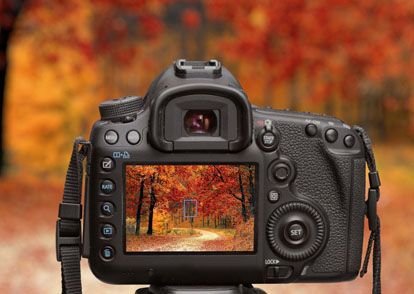
If you’ve ever felt confused by photography terms like aperture, ISO, or shutter speed, or have trouble remembering the difference between overexposure and underexposure, you’re not alone.
Not only that, but photography terms are often explained in ways that feel overly technical or leave you with more questions than answers.
Whether you’re shooting with a DSLR, mirrorless camera, or even your phone, these technical and fundamental photography terms will help you go from questions to answers.
Feel like browsing first? Explore away — then download your free copy and continue building your skills.
1. Aperture: Your camera lens comprises overlapping blades to allow more light or less light to enter through the lens. Aperture relates to the amount of light admitted. By way of aperture settings, “open up” the blades to admit more light; “stop down” the aperture to close the blades and reduce light, as set by the camera's aperture setting. An aperture setting of f/2.8, for example, opens the blades to let in more light, while f/16 closes the blades and reduces light.
For help understanding the what and why of aperture, please click aperture basics for photographers.
2. Fast lens: A fast lens can achieve the same exposure as a non-fast lens but with a faster shutter speed. As mentioned above, the amount a lens opens to admit light is called the aperture or f-stop (number). Relating this to a lens, and the following occurs: a lens with an f/2.8 aperture is considered a fast lens compared to a f/5.6 or f/6.3 lens, which requires a slower shutter speed to achieve the same exposure results.
3.Shutter speed: This relates to the time when the camera shutter is open to allow light onto the camera sensor when you take a photo. A faster shutter speed example for a quick capture is 1/2000th of a second, think capturing action. A slower shutter speed example is 1/60th of a second, or 10 seconds, think feathery-looking waterfalls, or night sky photography.
For creative examples and to learn more, please click onshutter speed for slow motion.
4. ISO: ISO is identified in your camera with numeric settings such as 100, 200, 400, 6400, 12800, and higher values. ISO is a camera’s film or digital sensor sensitivity to light. Using a higher ISO is helpful in low-light situations and when you need a faster shutter speed, as it increases sensitivity, making it easier to photograph your subject. Using a lower numerical value helps avoid digital noise, which may occur at higher values.
To delve deeper into the topic, please click onISO photography basics.
5. Exposure - When you view an image and notice how light or dark it is, you are observing the exposure and how you have captured the scene. For example, are you happy with the results, in other words, the lighting, or do you feel it’s too bright or too dark? This is a short, to-the-point definition of exposure.
For an introduction to a useful camera feature, please click on how to read a histogram.
6. Overexposed: When your photos are too light, the colour is washed out, and areas may appear white with no visible detail. Unintentionally overexposed images result from too much light hitting the camera sensor or film due to incorrect camera settings. This may be caused by a too-slow shutter speed, for example. Perhaps you took a photo at 1/100 of a second, when 1/1000 would have been better suited to the scene. Aperture and ISO settings will also affect exposure.
7. Underexposed: Images are too dark, an excessive shadow may occur, detail is non-descript and may blend into the shadows, and the colours may be dull. Unintentional underexposed images result from insufficient light hitting the camera sensor or film due to incorrect camera settings. As with overexposure, the shutter speed may be too fast, or the aperture and ISO need to be adjusted based on the scene.
8. Exposure triangle: The exposure triangle consists of the aperture, shutter speed, and ISO. These three elements work together to help you render the correct exposure. Additionally, adjusting the settings can alter your photos’ mood or look and inspire creativity by varying the results beyond just exposure. This is especially true when you shoot in the camera's manual mode, giving you more control over the results.
For more in-depth information, please click on exposure triangle for beginner photographers.
9. Digital noise: Digital noise is caused by a high ISO setting beyond the camera’s capability to capture your subject in the environment, producing undesirable results. Digital noise is often represented with grainy-looking distortion and non-flattering colour tones.
10. Rule-of-Thirds: The rule of thirds is a guideline for composing your photos. When you place your primary subject in the top, bottom, left, or right one-third of the frame, or scene, you have utilized the rule of thirds. This is compared to placing the subject in the center of the frame or scene. However, at times, powerful results can be achieved by placing your subject in the center when warranted for a stronger composition or arrangement of the scene's elements. Following the rule of thirds guideline usually results in a more pleasing and substantial composition.
Looking for helpful examples and quick results? Please click on easy photography composition tips.
